

1.In the question below, a statement is followed by two conclusions based on the statement. Study the conclusions and select the correct option as the answer. Statement: K = M < P = H; J = G ≥ K; I < P Conclusion: I. P > G II. G > I
(A) Either I or II follow
(B) Both I and II follows
(C) Only II follows
(D) None follows
(E) Only I follows
2.In these question relationship between different elements are shown in the statements. These elements are followed by conclusions. Statements: A > B < C = D; B < E < F Conclusions: I. A > E II. D > F
(A) Only conclusion I follows
(B) Only conclusion II follows
(C) Either conclusion I or II follows
(D) Neither conclusion I nor II follows
(E) Both conclusions I and II follows
3.In this question relationship between different elements is shown in the statements. The statements are followed by two conclusions.
Choose the correct option.Statements: P≥E>R=C, N<T=R Conclusions: I. R=T II. E≥N
(A) If only conclusion I is true
(B) If only conclusion II is true
(C) If either conclusion I or II is true
(D) If neither conclusion I nor II is true
(E) If both conclusion I and II are true
Directions (04 – 07): Study the given information carefully and answer the questions below it: In a certain coded language some statements
are coded as follow, stable condition multiple place is coded as ciz lip mob tum earth simple place glass is coded as pik mob gib hip apply stable test player is coded as lip naz pip jin multiple game player simple is coded as tum dip jin pik
4.Which of the following letter is coded as’pik’?
(A) earth
(B) simple
(C) player
(D) glass
(E) multiple
5.What is the code for ‘glass’ in the given coded
language?
(A) hip
(B) pik
(C) gib
(D) mob
(E) Cannot be determine
6.In a certain coded language, ‘strict rule game’ is coded as ‘dip jim hdw’ then, what is the code for ‘simple rule apply’?
(A) ‘gty hdw per’
(B) ‘jim pik pip’
(C) ‘pik naz jim’
(D) ‘ciz hdw jim’
(E) Cannot be determined
7.The code ‘ciz mob’ is the coded language of which of the following?
(A) place test
(B) player condition
(C) apply game
(D) place condition
(E) multiple condition
8.In each of the questions below are given some statements followed by some conclusions. You have to take the given statements to be true even if they seem to be at variance from commonly known facts. Read all the conclusions and then decide which of the given conclusions logically follows from the given statements disregarding commonly known facts. Statements: All arcs are minutes. Some minutes are tracks. All tracks are claps. Conclusions: I. Some claps are arcs. II. Some claps are minutes.
(A) If only Conclusion I follows.
(B) If only Conclusion II follows.
(C) If either Conclusion I or II follows.
(D) If neither Conclusion I nor II follows.
(E) If both Conclusions I and II follow.
Directions (09 – 12) : Eight people A, D, G, I, K, N,Q, and T were born in different years viz.2000, 2003, 2005, 2008, 2010, 2013, 2015,and 2018 not necessarily in the similar order. No one was born between I and N. Only one person was born between N who is not the youngest of all and D. No one was born between A and T. K was born in an oddnumbered year. T was born in a leap year. I was not born in an even-numbered year. G who is not the oldest of all is three years older than Q. Three people were born between A and D.
9.Who is the oldest of all ?
(A) K
(B) G
(C) D
(D) I
(E) T
10.How many people were born between I and K?
(A) 5
(B) 3
(C) 4
(D) 6
(E) 2
11.If Y was born in a leap year between T and G, then Y is __ year(s) older than K.
(A) Three
(B) Five
(C) Four
(D) One
(E) Two
12.Who among the following is younger than A ?
(A) G
(B) T
(C) I
(D) D
(E) N
Directions [13-17]: Six people M, P, K, S, O and I are sitting around a triangular table. Three people are sitting at the corner of the table and facing outwards. The rest three are sitting in the middle of the edge of the table and facing inwards. M sits immediate right of S. Two people sit between M and O. K faces outwards. M and P is an immediate neighbors to each other. P and I is not an immediate neighbour of each other.
13.Who among the sits immediate left of I?
(A) S
(B) O
(C) K
(D) P
(E) M
14.As S is related to K in the same was O is related to _?
(A) S
(B) P
(C) I
(D) M
(E) None of the above
15.How many people are sitting between M and K, when counted to the left of M?
(A) Three
(B) None
(C) One
(D) More than three
(E) Two
16.Who sits second to the left of O?
(A) S
(B) M
(C) P
(D) I
(E) K
17.How is S related to P ?
(A) Immediate left
(B) Second to the right
(C) Third to the left
(D) Second to the left
(E) Immediate right Directions
[18-20]: Certain number of persons sit in a linear row from left to right, and all are facing in the north direction. M sits third to the left of O. Four persons sit between Q and . R sits immediate to the right of Q. T who sits third from one of the ends, is second to
the right of P. Four persons sit between P and M. Q does not sit adjacent to T. Eight persons sit between N and S, who sits second to the
right of R. N sits to the right of M, but left of Q.
18.How many persons sit to the left of N?
(A) 10
(B) 8
(C) 9
(D) 7
(E) 6
19.How many persons sit between T and R ?
(A) 9
(B) 12
(C) 14
(D) 11
(E) 15
20.What is the position of S with respect to O?
(A) Eighth to the right
(B) Seventh to the right
(C) Fifth to the left
(D) Seventh to the left
(E) None of these
Directions [21-24]: Eight cartons C1, C2, C3, C4, C5, C6, C7 and C8 are kept from top to bottom in a stack but not necessarily in the same order. The bottommost position in the stack is numbered as 1, above it as 2, and so on. C3 is kept immediately below C7 and immediately above C5. Five cartons are kept in between C2 and C6, which is kept above C2. Carton C1 is not kept at the bottommost position. Three cartons are kept in between C2 and C4, which is kept immediately below C8.
21.How many cartons are kept above carton C8?
(A) 1
(B) 2
(C) 3
(D) More than 3
(E) None
22.Carton C2 is kept immediately below carton
__.
(A) C5
(B) C6
(C) C3
(D) C7
(E) C4
23.Four of the following cartons are related to each other in some way and thus form a group. Which of the following cartons does not belong to that group?
(A) Carton C5
(B) Carton C7
(C) Carton C2
(D) Carton C8
(E) Carton C1
24.How many cartons are kept in between carton C6 and carton C3?
(A) 1
(B) 2
(C) 3
(D) 4
(E) 5
Directions (25 – 26): Answer the questions based on the information given below. Seven cottages A, B, C, D, E, F and G are situated in an area. E is 4 km to the east of B. F is 4 km to south of A. C is 2 km to east of A. D is 4km to the north of G. G is 4 km to the west of C. D is 2 km to the west
of E.
25.How far is cottage E from cottage F?
(A) 6 km
(B) 4 km
(C) 8 km
(D) 10 km
(E) 12 km
26.What is the direction of cottage E with respect to cottage G?
(A) North West
(B) South East
(C) North East
(D) South West
(E) None of these
Directions (27 – 28) : Read the following information and answer the given questions. There are 7 people namely A, B, C, D, E, F and G in a 3 generation family. D is the other in law of F. B is the brother in law of G. G is the son of C who is not a female. A ho is not the wife of B and has only one child. B has a niece.
27.Who is the husband of D?
(A) G
(B) B
(C) F
(D) E
(E) C
28.How many females are there in the family?
(A) 3
(B) 4
(C) 5
(D) Cant determined
(E) None of these
Directions [29-31]: Seven persons A, B, C, D, E, F and G lived in a building with 7 different floors. The floors were numbered 1-7 from bottom to top and no two persons lived on the same floor. Three persons lived between A and F. A lived somewhere above F. G lived immediately above A. Two persons lived between E and D. C lived immediately above E.
29.How many persons lived below B?
(A) None
(B) 1
(C) 2
(D) 3
(E) Cannot be determined
30.How many persons lived between E and F?
(A) None
(B) 1
(C) 2
(D) 3
(E) More than 3
31.What was the floor number of E?
(A) 1
(B) 2
(C) 3
(D) 4
(E) 5
Directions (32-35) : Study the following series carefully and answer the questions given below:
@ A 3 $ R % 5 < I > # V ≤ 6 B © 7 + O G 1
& 2 U 4 L D 9 E 8
32.If all the consonants are changed to its previous letter in English alphabets, then how many vowels are there in the new series?
(A) 5
(B) 6
(C) 7
(D) 8
(E) 9
33.How many symbols are there which are immediately followed by a number?
(A) None
(B) One
(C) Two
(D) Three
(E) More than three
34.If all the symbols are dropped, then how many numbers are there which are immediately preceded by a vowel?
(A) None
(B) One
(C) Two
(D) Three
(E) Four
35.If the elements from ‘@’ to ‘O’ is reversed,then which element is exactly in the midway between ‘#’ to ‘1’?
(A) %
(B) R
(C) $
(D) @
(E) 3
Quantitative Aptitude
36.A Book marked at Rs.500 is sold after giving two successive discounts of 10% and 5%. Find the selling price of the book (in rupees).
(A) 437.5
(B) 417.5
(C) 427.5
(D) 432.5
(E) 462.5
37.K started a business. He left at the end of eight months while P took over his business at the same time. The ratio of their capitals invested was 3:5 respectively. What was the respective ratio of their shares of profit at the end of the year?
(A) 5:3
(B) 2:5
(C) 7:10
(D) 12:5
(E) 6:5
38.The ratio in which liquid A of Rs.38 per litre is mixed with liquid B of Rs.45 per litre so as to gain 30% by selling the mixture at Rs.54.6
per litre is:
(A) 4: 5
(B) 5: 3
(C) 3: 4
(D) 3: 2
(E) 2: 1
39.Madhav and Keshav are running at 15 m/s and 20 m/s respectively. If Madhav covers a certain distance in 20 minutes, then in how much time Keshav can cover same distance?
(A) 12 minutes
(B) 15 minutes
(C) 10 minutes
(D) 8 minutes
(E) 25 minutes
40.Three pipes A, B, and C together can fill an empty tank in 12 minutes. Pipe A alone can fill it in 60 min and pipe B can fill it in 40 min. How long will the pipe C alone take to fill 3/4th of the tank it?
(A) 12 min
(B) 15 min
(C) 18 min
(D) 10 min
(E) 16 min
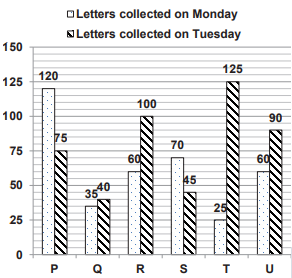
Directions (41-45): Study the following information carefully and answer the related questions. Following bar-graph represents the data regarding number of letters collected from different post boxes on Monday and Tuesday.
41. What is the respective ratio of number of letters collected from post box R to the number of letters collected from post box T on Monday and Tuesday together?
(A) 12: 11 (B) 8: 7
(C) 16: 15 (D) 6: 5
(E) 20: 19
42.What is the average number of letters collected from post box P, S and U on Tuesday?
(A) 90 (B) 60
(C) 70 (D) 85
(E) 55
43.Number of letters collected from post box U on Monday is what percent of the number of letters collected from same post box on Monday and Tuesday together?
(A) 48% (B) 64%
(C) 50% (D) 40%
(E) 56%
44.Number of letters collected from post boxes P and R together on Monday is how many more/less than the number of letters collected from post boxes S and T together on Tuesday?
(A) 10 (B) 25
(C) 20 (D) 40
(E) 15
45. Number of letters collected from post box Q on Monday is __% more than the number of letters collected from post box T on same day.
(A) 20% (B) 35%
(C) 30% (D) 25%
(E) 40%
46. Find the missing term in the following series.
6, 8, 14, 26, 46, ?
(A) 84 (B) 82
(C) 80 (D) 78
(E) 76
47.Find the wrong term in the series given below.
147, 196, 232, 254, 273, 282
(A) 147 (B) 232
(C) 254 (D) 273
(E) 196
48.Find the next term in the series. 5000, 4991, 4966, 4917, 4836, ?
(A) 4727 (B) 4715
(C) 4731 (D) 4723
(E) 4721
49.What value will come in place of question mark (?) in the following question? √144+? = 42 of 4 3 6
(A) 171 (B) 167
(C) 161 (D) 177
(E) 162
50.What value will come in place of question mark (?) in the following question? √256+? = 1 4 6 of 114
(A) 188 (B) 161
(C) 174 (D) 168
(E) 157
51. What value will come in place of question mark (?) in the following question? (?)2 + 73 = 402 – 32
(A) 23 (B) 31
(C) 55 (D) 35
(E) 51
52.What value will come in place of question mark (?) in the following question? 60% of 680 + 25% of 320 = ?
(A) 488 (B) 438
(C) 458 (D) 428
(E) 578
53.What value should come in place of question ark? {∛1728 – (√256 – √121)} × 5/7 = ?
(A) 20 (B) 15
(C) 5 (D) 9
(E) 10
54.What value will come in place of question mark (?) in the following question? 47 84 × 21 329 ×? = 14
(A) 386 (B) 376
(C) 392 (D) 388
(E) 378
55.What value should come in place of question mark? 45% of 500 = 320.18 – ?
(A) 106.28 (B) 95.18
(C) 76.28 (D) 85.36
(E) 98.18
56.What value will come in place of question mark (?) in the following question? 40 4 − 6 × 11 + √576 =?
(A) -28 (B) -46
(C) -32 (D) -26
(E) -30
57.What value will come in place of question mark (?) in the following question? ∛1331 – ∛8000 + ∛2197 = ?
(A) -2 (B) -4
(C) 3 (D) 7
(E) 4
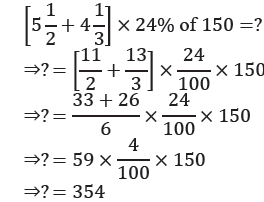
58.What value should come in place of question mark? [5 1 2 + 4 1 3 ] × 24% ∘ 𝑓𝑓150 =?
(A) 334 (B) 324
(C) 354 (D) 356
(E) 386
59. Kiran spent Rs 5475 on her parties, Rs 8525 on shopping from his monthly income and then she saved 36% of her monthly salary. What was her annual income?
(A) Rs 262500 (B) Rs 218700
(C) Rs 252500 (D) Rs 218800
(E) Rs 268700
60. The age of Rohan is 34 years, and his wife is 4 years younger than him. Find the respective ratio between the age of Rohan 4 years ago and age of wife 6 years hence?
(A) 6: 5 (B) 4: 7
(C) 5: 6 (D) 2: 5
(E) 3: 5
61. A question is followed by two statements. Read all the statements carefully and find which of the following statement(s) is/are sufficient to answer the question.
What is the length of the train? Statement I: The train crosses an 85 m long bridge in 10.5 seconds. Statement II: The train crosses a man sitting on a bench in 6.25 seconds.
(A) If the data given in both statements I and II together are necessary to answer the question.
(B) If the data in statement II alone are sufficient to answer the question, while the data in statement I alone are not sufficient to answer the question.
C) If the data either in statement I alone or in statement II alone are sufficient to answer the question.
(D) If the data in statement I alone are sufficient to answer the question, while the data in statement II alone are not sufficient to
answer the question.
(E) If the data given in both statements I and II together are not sufficient to answer the question.
62.In the following question, two statements numbered I and II are given. On solving them, we get quantities I and II, respectively. Solve for both the quantities and choose the correct option. Quantity I: The value of K and L is in the ratio of 5: 8. If 12 is added in both numbers, then ratio becomes 8: 11. What is the value of K? Quantity II: 20
(A) Quantity I ≤ Quantity II
(B) Quantity I ≥ Quantity II
(C) Quantity I < Quantity II (D) Quantity I > Quantity II
(E) Quantity I = Quantity II
63.Sum of length and breadth of a rectangle is 15 cm. product of length and breadth of the rectangle is 50 cm. find the difference between length and breadth?
(A) 25 cm (B) 5 cm
(C) 10 cm (D) 15 cm
(E) 20 cm
64.What approximate value will come in place of question mark (?) in the following question? (You are not expected to calculate the exact value.) 2116.00 ÷ 92.04 × 36.96 = ? + 28.96
(A) 822 (B) 702
(C) 897 (D) 672
(E) 807
65.What approximate value will come in place of question mark (?) in the following question? (You are not expected to calculate the exact value.) (?)2 + 7.933 = 8.062 – 18.96
(A) 32 (B) 4
(C) 20 (D) 28
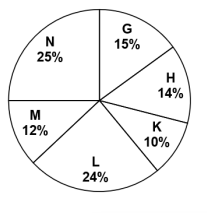
(E) 16 Directions(66-70) : Study the data given below and answer the following question: Below pie chart shows the percentage distribution of production of fertilizer (in lakh tonnes) by six companies in a year: Total production of fertilizer by all six companies = 72000 lakh tonnes
66. What is the ratio of production of fertilizer by companies K and M together to the production of fertilizer by companies G and N together?
(A) 12: 11 (B) 11: 20
(C) 11: 10 (D) 13: 20
(E) None of these
67. What is the difference between the production of fertilizer by G and L together and the production of fertilizer by K and H together?
(A) 9600 lakh tonnes
(B) 11200 lakh tonnes
(C) 10800 lakh tonnes
(D) 10400 lakh tonnes
(E) None of these
68.The production of fertilizer by H and N together is what percentage more or less than the production of fertilizer by G and M together?
(A) 33.33% (B) 36.36%
(C) 45.45% (D) 44.44%
(E) 55.55%
69.What is the average production of fertilizer by H, K, and N together?
(A) 18930 lakh tonnes (B) 12360 lakh tonnes
(C) 11760 lakh tonnes (D) 12760 lakh tonnes
(E) None of these
English Language
70.In the question given below, a sentence is given with two blanks, followed by five options, each having two words that may or may not fit in the blanks. From the given options, choose the one that has the correct pair of words to fit in the given blanks. She always went for something which was _ and that she could move beautifully in, that does not __ a fashion-conscious girl but somebody who is feeling wonderful in her own skin.
(A) offensive, representing
(B) fashionable, represent
(C) grateful, representation
(D) luxury, represents
(E) simple, represent
72.In the question given below, a sentence is given with one blank, followed by five options, each having a word that may or may not fit in the blank. From the given options, choose the one that gives the correct word that fits in the blank. The house is attractive and has all the _ services one would expect from a new building.
(A) Literally (B) Focuses
(C) Modern (D) Duration
(E) Length
73. In the following question, match the statement/s from column 1 with column 2 and find which of the following pairs of contextually and grammatically correct ense. COLUMN 1 COLUMN 2 A. She decorated the arty hall D. medicines for my throat pain. B. The doctor has xprescribed E. book that kept me awake all night.
C. I was reading a very good F. with balloons, streamers and flowers.
(A) A-F (B) A-E, B-F
(C) C-F, B-D (D) C-D
(E) A-D
74.In the following question, match the statement/s from column 1 with column 2 and find which of the following pairs of statements given in the options make/s contextually and grammatically correct sense. COLUMN 1 COLUMN 2 A. I was late for the lecture D. favourite day of week for me. B. Tuesday is definitely the E. 2nd week of August every year. C. My birthday comes in the F. by 5 minutes and couldn’t enter.
(A) A-E, C-D, B-F (B) A-D
(C) B-D (D) C-F, A-E
(E) C-D
75. A part of the sentence is highlighted. Below are given alternatives to the highlighted part which may improve the sentence. Choose the correct alternative. Tom mentioned that there were others on the island, but I have not see anyone yet.
(A) See anybody
(B) Watching someone
(C) Created anyone
(D) Saw anyone
(E) Seen anyone
76.In the following question, a sentence is given with a phrase highlighted in bold. Select the option given below that can replace the phrase in bold to make the entence grammatically and contextually correct and mark that as your answer. If the sentence is correct as it is, mark ‘No improvement required’ as the answer. I decided to follow your advices and took a vacation.
(A) yours advice
(B) yours advices
(C) your advice
(D) many advices
(E) No improvement required
77. In the question given below, a sentence is given with four words highlighted in bold. One of these four words may either be wrongly spelt or inappropriate in the context of the sentence. Find out the word, which is wrongly spelt or inappropriate, if any. If all the words are correctly spelt and appropriate in the context of the sentence, mark ‘All are correct’ as your answer. Straight
(A) after your last cigarette
(B) your body will begin to cleanse
(C) itself of tobacco
(D) toxins.
(A) B (B) C
(C) A (D) D
(E) All are correct
78.In the question given below, a sentence is given with five words highlighted in bold. One of these five words may either be wrongly spelt or inappropriate in the context of the sentence. Find out the word, which is wrongly spelt or inappropriate, if any, and mark the answer accordingly. Akademics (A) and employers are deeply
(B) concerned that (C) students are notsufficiently (D) prepared mathematically for(E) university courses.
(A) E (B) D
(C) C (D) B
(E) A
79.In the question below, a sentence is given with four words highlighted in bold. One of these four words may be either wrongly spelt or inappropriat in the context of the sentence. Find out the word, which is wrongly spelt or inappropriate, if any. If all the words are correctly s elt and appropriate in the context of the sentence, mark ‘All are correct’ as your answer. Ella complained
(A) that the company never
(B) gave her any recogniton
(C) for her
(D) work.
(A) C (B) D
(C) B (D) A
(E) All are correct
80.In the question given below, one part of the sentence may or may not have an error. Find out which part of the sentence has an error and select the appropriate ption. If the sentence is free from error, select ‘No error’. Ignore punctuation errors, if any. (A) If you do not understand (B) something someone is saying
(C) and wish you did, don’t be (D) shy about asking for clarification. (E) No error Directions [81-89]: Read the following passage carefully and answer the questions that follow. The Mouse family lived in the corner of an old barn, under the floor. There were the father and the mother, with two children. These two were the last of a large family. They were called Brownie and Bright Eyes. Brownie, the elder one, was a bold little mouse, and his mother was always afraid that he would get into mischief. Before going to hunt for food she would say to him “Now, Brownie, you must not go out of doors whenI am away. You must take care of little Bright
Eyes.” Brownie always promised to stay indoors and to be very careful not to go near Mrs Cat, who lived in the farmhouse. But one fateful night he forgot all about this promise, after the Father and Mother Mouse had gone out to hunt. Brownie said to littleBright Eyes: “Let us go out and hunt by ourselves. There is no fun down here. It is far too dull. I heard Father talking to Mother about a cupboard over in the farmhouse. He said there was cheese in it. Let us go and find that cupboard.” So Brownie and Bright Eyescrept out from under the floor. Then they ran through the old barn and slipped through a hole where the hens went out and in. “I think this is far enough,” said Bright Eyes, for shewas timid. “Nonsense,” said Brownie. “Let us go on.” Brownie went first. He made a runacross the farmyard, and Bright Eyes followed. The dogs barked and the horses neighed. But Brownie said: “I am not afraid of anyone. Here is an open door; let us pop inside, and see what is to be seen.” They went in and found themselves in the kitchen of the farmhouse. There, in the corner, was a cupboard. “Here is the very place,” said Brownie, “for I smell the cheese. We are lucky mice.” When they got inside the cupboard, sure enough, there was thecheese. It was just a little bit. So the two mice began to nibble it. Brownie wanted the bigger share, so he pulled the cheese away from Bright Eyes. This __ a dish, and wakened Mrs Cat. She made one spring and upset all the dishes. So Bright Eyes ran away as fast as she could. When she got home under the floor in the old barn, Bright Eyes was all shaking with fear. “Where is your brother, my dear?” said the Mother Mouse. “I don’t know,” said Bright Eyes, and then she told all that had happened. “I know where he has gone,” said Mrs Mouse. “The poor thing! But that comes of doing what he was told not to do.” SoBrownie never came back as he fell prey to Mrs Cat.
(A) The people who get scared easily remainsafe.
(B) We should not go out of the house whenour parents are away.
(C) We should obey our parents.
(D) Cats are dangerous creatures.
(E) We should show courage during tough times.
81.What is the moral of the story?
82.Which of the following words best describes Bright Eyes’ personality?
(A) Smart (B) Joyful
(C) Fainthearted (D) Dejected
(E) Agonized
83.What were Brownie and Bright Eyes looking for in the kitchen?
(A) A piece of cheese
(B) Mrs Cat
(C) The owner of the kitchen who cooked delicious food.
(D) Their parents
(E) A loaf of bread
84.Which of the following animals has not been mentioned in the passage?
(A) Cat (B) Hen
(C) Dog (D) Horse
(E) Duck
85.
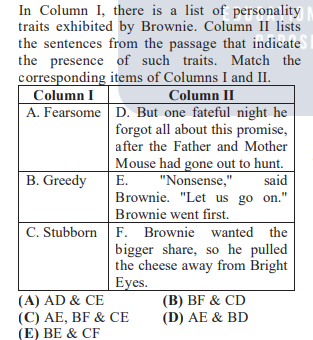
86. Which of the following words is most similar in meaning to the word ‘fateful’ mentioned in BOLD in the passage?
(A) Fortunate (B) Auspicious
(C) Catastrophic (D) Monotonous
(E) Tiresome
87. What did Mrs Mouse mean when she said “I know where he has gone. The poor thing!”?
(A) Brownie feasted on the cheese with joy.
(B) Brownie left his home to live an independent life.
(C) Brownie sacrificed his life to save his younger sister.
(D) Brownie was eaten by Mrs Cat.
(E) Brownie got lost on the way and couldn’t his way home
88. Which of the following words can grammatically and contextually fill the blank given in the passage?
(A) Rattled (B) Liability
(C) Pretty (D) Collated
(E) Fully
89. Which of the following is/are TRUE as per the passage? I. Brownie and Bright Eyes got to eat the piece of cheese they were looking for. II. The mouse family lived under the floor of an old barn. III. The younger sibling was the mischievous one.
(A) Only I and II
(B) Only II
(C) All I, II and III
(D) Only I and III
(E) Only I
90. In the following question, a sentence is given which is divided into five parts, part in bold is grammatically correct. Out of the other four parts, one part contains an error, if none of the parts has an error, mark your answer as No error. Much later, in the darkest part/ of the night, Dean’s mind (A)/ was creating picture
stories to (B)/ amuse it while his body lay in frozen and (C)/ unmoving slumber like a fallen mannequin. (D)/ No error (E)
(A) B (B) E
(C) D (D) A
(E) C
91.In the following question, a sentence is given divided into four parts (A), (B), (C), (D). The error, if any, will only be in one part of the sentence. Choose the option with the part containing the error and mark it as your answer. If the sentence is free from errors, mark ‘No error’ as your answer. A new meta-analysis combined the an data
(A) / from seven controlled studies
(B) / evaluating the effects of skipping breakfast
(C) / on body composition and cardio metabolic risk factors.
(D) (A) D
(B) C
(C) B
(D) A
(E) No error Directions [92-96]: In the question given below, a set of sentences is given, which when properly sequenced form a coherent paragraph. Arrange the sentences in the correct sequence and answer the questions that follow. P: He bought some cheap cheese to bake it. Q: He p ured the cheese along with some vegetables and ate a slice of cheese after that. R: “Oh no! If we put it on our pizza, it will S: One day, Charlie wanted to bake pizza. T: “This cheese is bitter”, said Charlie as he tasted the cheese.
92. Which of these should be LAST sentence after rearrangement?
(A) P (B) Q
(C) T (D) R
(E) S
93. Which of these should be FIRST sentence after rearrangement?
(A) P (B) Q
(C) R (D) S
(E) T
94.Which of these should be SECOND sentence after rearrangement?
(A) P (B) Q
(C) R (D) S(E) T
95. Which of these should be THIRD sentence after rearrangement?
(A) P (B) R
(C) S (D) T
(E) Q
96. Which of these should be FOURTH sentence after rearrangement?
(A) P (B) Q
(C) R (D) S
(E) T
97. In the question given below, a sentence is given with one blank, followed by five options, each having a word that may or may not fit in the blank. From the given options, choose the one that gives the correct word that fits in the blank. These flowers are brightly coloured in order to _ butterflies.
(A) Make (B) Attract
(C) Steep (D) Joyous
(E) Fly
98.In the question given below, a sentence is given with one blank, followed by five options, each having a word that may or may not fit in the blank. From the given options, choose the one that gives the correct word that fits in the blank. After years of __, she finally achieved success on the big screen.
(A) Honour (B) Fail
(C) Rejection (D) Laughter
(E) Regal
99.In the question given below, a sentence is given with one blank, followed by five options, each having a word that may or may not fit in the blank. From the given options, choose the one that gives the correct word that fits in the blank. She waved goodbye to her parents at the __ and sobbed her heart out.
(A) Permit (B) Lend
(C) Inquire (D) Airport
(E) Schedule
100.In the question given below, a sentence is given with one blank, followed by five options, each having a word that may or may not fit in the blank. From the given options, choose the one that gives the correct word that fits in the blank. Sophie sat back for a minute to _ her next move in the game.
(A) Ponder (B) Charming
(C) Exhibition (D) Hurried
(E) Opens
Solution
Reasoning Aptitude
1. Answer: (D) Given statement is K = M < P = H; J = G ≥ K; I < P G ≥ K = M < P. Here, no definite relation can be established. So, conclusion I does not follow. G ≥ K = M < P > I. Here, no definite relation can be established. So, conclusion II does not follow. So, None follows.
2. Answer: (D) Given: – A > B < C = D; B < E < F. Combining both, we will get: – A > B < E < F and F > E > B < C = D. We cannot compare A and E. Also, we cannot compare D and F. So, both the conclusions are false.
3. Answer: (A) From the Statements: P≥E>R=C NR=T>N Thus, R=T is true. Hence conclusion I follows Again, E≥N E>N is true. So E≥N is not true. Hence conclusion II doesn’t follow
4.Answer: (B) As per the given statements, stable condition multiple place is coded as ciz lip mob tum——I earth simple place glass is coded as pik mob gib hip————-II
apply stable test player is coded as lip nazpip jin—————III multiple game player simple is coded as tum dip jin pik———IV From I and II place = mob
From I and III, stable = lip From I and IV, multiple = tum From II and IV, simple = pik From III and IV, player = jin From I, condition = ciz
From II, earth = gib/hip glass = hip/gib From III, pply = pip/naz test = naz/pip From IV, game = dip So,
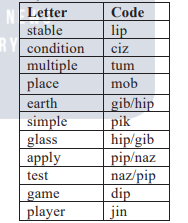
As we know, simple is coded as pik.
5.Answer: (E) As we know, the code of glass is either hip or gib. So, we have no definite answer to this question
6.Answer: (E) As we know that, simple is coded as pik rule is coded as jim/hdw apply is coded as pip/naz Thus, we have no definite code for ‘simple rule apply’.
7.Answer: (D) As we know that, ciz is the code of condition mob is the code of place
8.Answer: (B)The statements can be represented as:
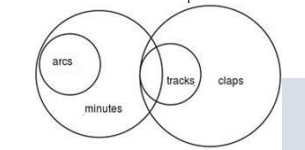
Only conclusion II follows
9.
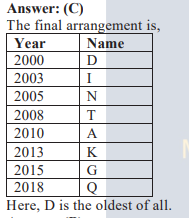
10.Answer: (B)
Here, three people were born between I and
K
11.Answer: (D)
Here, Y was born in 2012 and Y is one year
older than K.
12.Answer: (A)Here, G is younger than A
13.Answer: (A)Finally, we get,
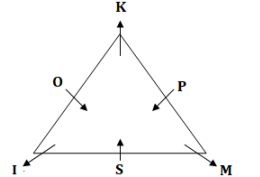
S sits immediate left of I
14.Answer: (D)As S is related to K in the same way O is related to M
15.Answer: (C) One person is sitting between M and K, when counted to the left of M.
16. nswer: (C) P sits second to the left of O.
17.Answer: (D)S sits second to the left of P. Answer: (18-20) M sits third to the left of O. Four persons sit between Q and O.
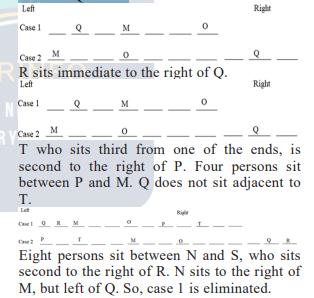
18.Answer: (D)Seven persons sit to the left of N
19.Answer: (D)Eleven persons sit between T and R.
20.Answer: (A)S sits eighth to the right of O.Answer: (21-24)This is the final arrangement.
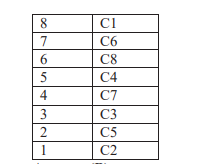
21.Answer: (B)
Two cartons are kept above carton C8.
22.Answer: (A)
Carton C2 is kept immediately below carton
C5
23.Answer: (C)
Except for Carton C2 all other cartons are
kept at the even number position
24.Answer: (C)
Three cartons are kept in between carton C6
and carton C3.
Answer: (25-26)
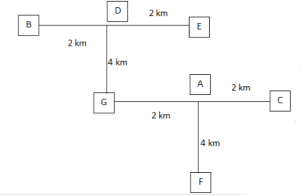
25.Answer: (C)
Cottage E is 8 km from Cottage F. Hence,
option c.
26.Answer: (C)
Cottage E is North East of Cottage G. Hence,
option c.
27.Answer: (A)Since D is the mother in law of F and G is the son of C, there are three possible cases. Case 1: D is the wife of C. It implies F is the wife of G. Now it is possible that B is the brother of F or G’s sister’s husband is B. A can be F’s or B’s child but A has one child and it is a three generation family so it is not possible. Also A cannot be the wife of B. Case 2: D is the wife of B. If E is the child of D then A has to be C’s wife but A has only one child. So this case is also rejected. t means D is the wife of G. It means A is married to C and they have one child. B has a niece which means E is the niece of B and F is her husband. The final figure is shown below:
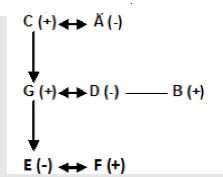
G is the husband of D. Hence, option a
28.nswer: (A)
There are 3 females in the family.
Hence, option a.
29.Answer: (C)
Thus, the final arrangement is as follows:
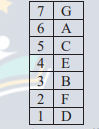
2 persons lived below B
30.Answer: (B)Only 1 person lived between E and F
31.Answer: (D)E lived on 4th floor
32.Answer: (C) If all the consonants are changed to its previous letter in English alphabets, @ A 3 $ Q % 5 < I > # U ≤ 6 A © 7 + O F 1 & 2 U 4 K C 9 E 8
33.Answer: (E)SYMBOL – NUMBER → %5, ≤6, ©7, &2
34.Answer: (D) @ A 3 $ R % 5 < I > # V ≤ 6 B © 7 + O G 1 & 2 U 4 L D 9 E 8 If all the symbols are dropped, → Vowel – Number A 3 R 5 I V 6 B 7 O G 1 2 U 4 L D 9 E 8
35.Answer: (B) If the elements from ‘@’ to ‘O’ is reversed, O + 7 © B 6 ≤ V # > I < 5 % R $ 3 A @ G 1 & 2 U 4 L D 9 E 8
Quantitative Aptitude
36.Answer: (C)Required SP of the book = 500 × (9/10) ×(19/20) = Rs.427.5
37.Answer: (E)Ratio of their shares of profit = ratio of their investments Ratio of the investments by K and P = (3 × 8):(5 × 4) = 6:5
38.Answer: (C)Selling price of mixture = Rs.54.6 Profit% = 30% Cost price of mixture = 54.6 × 100/130 = Rs.42 per L Using alligation method,
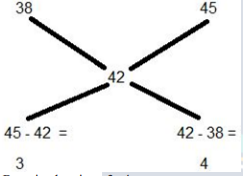
Required ratio = 3: 4
39.Answer: (B) Speed of Madhav = 15 m/s = 15 × 18/5 = 54 km/h And speed of Keshav = 20 m/s = 20 × 18/5 = 72 km/h Distance covered by Madhav in 20 minutes = (54 × 20/60) = 18 km Required time = (18)/72 = 0.25 hours = 0.25 × 60 minutes = 15 minutes
40.Answer: (C) Total capacity of tank = LCM of 12, 60, and 40 = 120 units Efficiency of pipe A = 120/60 = 2 units per min Efficiency of pipe B = 120/40 = 3 units per in Efficiency of all three pipes = 120/12 = 10 units per min Efficiency of pipe C = 10 – 5 = 5 units per min 3/4th capacity of tank = 120 × 3/4 = 90 units Required time = 90/5 = 18 min.
41.Answer: (C)
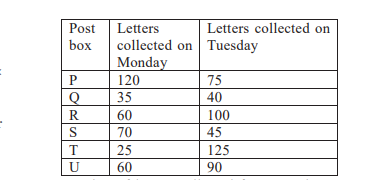
Number of letters collected from post box R on Monday and Tuesday together = 60 + 100 = 160
And, number of letters collected from post box T on Monday and Tuesday together = 25 + 125 = 150
Therefore, ratio = 160: 150 = 16: 15
42.Answer: (C) Average number of letters collected from post box P, S and U on Tuesday
= (75 + 45 + 90)/3
= 210/3
= 70
43.Answer: (D)
Number of letters collected from post box U
on Monday = 60
And, number of letters collected from post
box U on Monday and Tuesday together = 6090 = 150
Therefore, percentage = (60/150) × 100
= 40%
44.Answer: (A)
Number of letters collected from post boxes P
and R together on Monday = 120 + 60 = 180
And, number of letters collected from post
boxes S and T together on Tuesday
= 45 + 125 = 170
Therefore, difference = 180 – 170 = 10
45.Answer: (E)
Number of letters collected from post box Q
on Monday = 35
Number of letters collected from post box T
on Monday = 25
Therefore, percentage = ((35 – 25)/25) × 100
= 40%
46.Answer: (E)
Logic in the series:
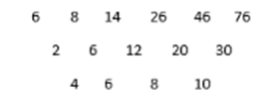
Hence, missing term of the series = 76
47.Answer: (C)
The logic for the given sereis.
147 + 72 = 196
196 + 62 = 232
232 + 52 = 257
257 + 42 = 273
272 + 32 = 282
48.Answer: (B)
The pattern is as follows:
5000 – 32 = 4991
4991 – 52 = 4966
4966 – 72 = 4917
4917 – 92 = 4836
4836 – 112 = 4715
49.Answer: (D)
? = 42 × (27/6) – √144
= 7 × 27 – 12
= 189 – 12 = 177
50.Answer: (C)
? = 114 × (10/6) – √256
= 19 × 10 – 16
= 190 – 16 = 174
51.Answer: (D)
(?)2 = 402 – 32 – 73
= 1600 – 32 – 343 = 1225
So, ? = 35
52.Answer: (A)
? = (60 × 680/100) + (25 × 320/100)
= (40800/100) + (8000/100)
= 408 + 80 = 488
53.Answer: (C)
{∛1728 – (√256 – √121)} × 5/7 = ?
=> ? = (12 – 16 + 11) × 5/7
=> ? = 5
54.Answer: (C)
? = (14 × 329 × 84)/(47 × 21)
= 14 × (329/47) × (84/21) = 14 × 7 × 4 = 392
55.Answer: (B)
=> 225 = 320.18 – ?
=> ? = 95.18
=> 95.18
56.Answer: (C)
? = (40/4) – 6 x 11 + √576
= 10 – 66 + 24
=-32
57.Answer: (E)
113 = 1331, 203 = 8000, 133 = 2197
? = ∛1331 – ∛8000 + ∛2197
= 11 – 20 + 13 = 4
58.Answer: (C)
59.Answer: (A) Let the monthly income of Kiran= Rs x (100 – 36) % of x= (5475 + 8525)
64% of x = 14000 x = (14000 × 100)/ 64 = 21875 So, annual income= 21875 × 12 = Rs 262500
60.Answer: (C)Rohan = 34 years Wife = 34 – 4 = 30 years Age of Rohan 4 years ago = 34 – 4 = 30 years
Age of wife 6 years hence = 30 + 6 = 36 years Required ratio = 30: 36 = 5: 6
61.Answer: (A) Let length of the train = L meters We know, speed = distance covered/time taken From statement I: The train crosses an 85 m long bridge in 10.5 seconds. Speed of train = (L + 85)/10.5..(i) From statement II: The train crosses a man sitting on a bench in 6.25 seconds. Speed of train = L/6.25..(ii) From statement I and II: From (i) and (ii), we get L + 85)/10.5 = L/6.25 L + 85 = 1.68L 0.68L = 85 L = 125 Hence, the data given in both statements I and II together are necessary to answer the question.
62.Answer: (E) Quantity I: Let K = 5x and L = 8x (5x + 12)/(8x + 12) = 8/11 => 55x + 132 = 64x + 96 => 9x = 36 => x = 4 Hence, K = 4 × 5 =20
Quantity II: 20 Hence, Quantity I = Quantity I
63.Answer: (B) Length + breadth = 15 Length × breadth = 50Length – breadth = √15 × 15 − 4 × 50 Length – breadth = 5 cm
64.Answer: (A) ? = 2116 ÷ 92 × 37 – 29 = 23 × 37 – 29
= 851 – 29 = 822
65.Answer: (E) (?)2 ≈ 282 – 19 – 83 = 784 – 19 – 512 = 253
So, ? ≈ 16
66Answer: (B)
Required ratio = (10 + 12): (15 + 25) = 11: 20
67.Answer: (C) Required difference = 72000 × (15 + 24 – 10 –
14)/100 = 10800 lakh tonnes
68.Answer: (D) Required percentage = (14 + 25 – 15 – 12)/(1512) × 100 = 44.44%V
69.Answer: (C) Required average = 72000 × (14 + 10 +
25)/300 = 11760 lakh tonnes
70.Answer: (A) Required percentage = (14 + 24)/(12 + 25) ×
100 = 102.70%
English Language
71.Answer: (E) An adjective would fit in the first blank to modify the noun ‘something’ and a base form of verb would fit in t e second blank as ‘does’ precedes the blank which is always followed by a base form of verb. The sentence conveys that the girl is not fashion-conscious, so logically she on’t select stuff that is ‘fashionable’. As per the context, ‘offens ve’ is inapt to use. Also, being ‘grateful’ is a quality of humans, not things. ‘Represents’ is a third person present and thus, eliminated. Also, in a sentence, we use the base form of main verb after ‘does’
72.Answer: (C)The sentence talks about a house and the services it provides. The blank requires an adjective to qualify the noun ‘services’. Option c) fits in the blank as it is both grammatically and contextually correct. Option a) is eliminated as it is an adverb. Option b) is eliminated as it is a verb and a
noun. Options d) and e) are eliminated as they are nouns.
73.Answer: (A) The correctly matched pairs are: A-F, B-D, and C-E. A-F – Statement A talks about a girl decorating a ‘party hall’ which is matched by
‘balloons’, ‘streamers’, ‘flowers’ from statement F. B-D – Statement B talks about the prescription of the ‘doctor’ which is matched by ‘medicines’ from state ent D.
C-E – Statement C is about ‘reading’ which is matched by ‘book’ from statement E.
74.Answer: (C) The correctly matched pairs are: A-F, B-D, and C-E. A-F – Statement A talks about the speaker who was ‘late for the lecture’ which is matched with ‘by 5 minutes’ (the duration by which he was late) from statement F. B-D – Statement B talks about ‘Tuesday’ which is matched with ‘favourite day’ from statement D conveying the fact that Tuesday s the favourite day of the speaker. C-E – Statement C talks about the speaker’s ‘birthday’ which is matched with ‘2nd week of August’ (the week in which the birthday falls) from statement E.
75.Answer: ( ) The auxiliary verb ‘have’ is followed by the past participle form of the main verb. Only options c) and e) contain the past participle form of the verb (i.e., ‘created’ and ‘seen’ respectively). ‘See’ is the base form of the verb. (Used in the given phrase and option a)) ‘Watching’ is the present participle form of
the verb. (Used in option b)) ‘Saw’ is the past simple form of the verb. (Used in option d) Hence, all these are incorrect Created’ means ‘to bring something into existence’. It gives no logical meaning to the sentence. So, replacing the highlighted phrase with ‘seen anyone’ improves the sentence. It givesthe meaning that the speaker has not spotted anyone on the island yet. Hence, option e) is correct. Note: Auxiliary verb: A verb that gives grammatical information that is not given by
the main verb of a sentence. It supports the main verb. Auxiliary verbs help to form the various tenses, moods, and voices of other verbs. The principal ones are be, do, and have. Example: She will sing a song tomorrow. Here, ‘will’ is the auxiliary verb that supports the main verb ‘sin
76.Answer: (C) ‘Advice’ is an uncountable noun. So, we cannot form its plural noun by adding ‘s’ at the end. So, the highlighted part of the sentence is grammatically incorrect. Similarly, options (b) and (d) are also eliminated. The possessive pronoun ‘yours’ is equivalent to ‘your + noun’. Since the noun is already defined in the sentence, we should not use the possessive pronoun. In option (c), ‘your’ is a possessive adjective, and it follows the uncountable noun ‘advice’. Option (c) is the one that fits correctly in the sentence as it
follows all the grammatical conditions mentioned above and brings out a meaningful sentence. Hence, option (c) is the correct
answer.
77.Answer: (C)The correct spelling of the word (B) is cigarette. The rest need not be changed.
78.Answer: (E)The word ‘akademics’ is misspelt and the correct word is ‘academics’. Rest of the words are correctly spelt and appropriately used.
79.Answer: (A) Word C is incorrectly spelt. The correct spelling is: Recognition – a public show of respect for somebody’s work or actions.
80.Answer: (E)There is no error in the given sentence.
81.Answer: (C) The moral of the story is that we should obey our parents as they try to protect us from potentially harmful situations. Brownie did
not obey his mom and ventured out to look for food. This resulted in him getting caught by the cat. Had he obeyed his mother, he
would have been safe.
82.Answer: (C) In the 2nd paragraph, Bright Eyes is described s ‘timid’: “I think this is far enough,” said Bright Eyes, for she was timid.” ‘Timid’
means ‘easily scared’. Let us look at the given options: ‘Fainthearted’ also means ‘easily scared’ ‘Dejected’ means ‘depressed’. ‘Agonized’
means ‘in pain’. Out of the given options, ‘fainthearted’ best describes Bright Eyes’ personality.
83.Answer: (A) Brownie and Bright Eyes were looking for a piece of cheese that Brownie overheard his father talking about. This is illustrated in the 2nd paragraph: “I heard Father talking to Mother about a cupboard over in the farmhouse. He said there was cheese in it.”
84.Answer: (E) The animals – cat, hen, dog and horse are mentioned in the passage. Duck has not been mentioned anywhere in the passage.
‘Cat’ is mentioned multiple times as “Mrs Cat” in the passage. ‘Hen’ is mentioned in the 2nd paragraph: “The n they ran through the old
barn, and slipped through a hole where the hens went out and in.” ‘Dog’ and ‘horse’ are also mentioned in the 2nd paragraph: “The
dogs barked and the horses neighed.”
85.Answer: (B) The correctly matched pairs are B-F and C-D. B-F: Statement F talks about Brownie snatching cheese from his sister (for the
bigger share). This indicates greedy behaviour. C-D: Statement D talks about Brownie not obeying his mother’s advice to stay indoors.
This indicates stubborn behaviour. ‘Fearsome’ has two meanings. One is ‘causing fear’. The other is ‘timid’. None of these qualities describe Brownie and none is illustrated in any of the sentences in column II.
86.Answer: (C) ‘Fateful’ means ‘having an important effect on the future, usually a negative one’. Let us look at the options: ‘Catastrophic’ means ‘tragic and disastrous’. ‘Monotonous means ‘boring’. ‘Auspicious’ means ‘that seems likely to be successful in the future’. Options a) and b) are opposite in meaning to the given word. Options d) and e) are unrelated. Option c) is the most similar in
meaning to the given word.
87. Answer: (D) Brownie’s mother had told him to stay indoors and take care of his little sister. When she heard of the entire story from Bright Eyes
about Mrs Cat appearing when they were eating the cheese, she knew that Mrs Cat had caught him. This meant that he was most
likely eaten by the cat. This is hinted at in the last sentence of the passage and captured in option d)
88.Answer: (A) The blank requires a verb to connect the ‘this’ and the noun ‘dish’. Option b) is eliminated as it is a noun. Option e) is eliminated as it is an adverb. Option c) is eliminated as it is an adjective. ‘Pretty’ also acts as an adverb, noun and verb; as a verb, it means to make pretty
or attractive. This meaning is not in line with the context of the sentence. To understand the context, let us look at the preceding sentence. The preceding sentence talks about Brownie snatching the cheese from his sister. Now let us focus on the sentence: This __ a dish, and wakened Mrs. Cat. There are two clauses in the sentence. The second clause talks about the cat waking up suddenly. This could be because of noise.
The blank in the first clause could be a verb describing noise or a sound. ‘Rattled’ means ‘to make a noise like hard things hitting each other’. ‘Collated’ means ‘to collect information from different places in order to put it ogether, examine and compare it’. ‘Collated’ is a contextual misfit. ‘Rattled’ fits the blank contextually and grammatically.
89.Answer: (A) Statement I is true. This is illustrated in the 3rd paragraph: “So the two mice began to nibble it.” Statement II is true. This is illustrated in the 1st sentence of the 1st paragraph: “The Mouse family lived in the corner of an old barn, under the floor.” Statement III is not true. Brownie, who did all the mischief throughout the story, was the elder sibling. Bright Eyes, who was the timid mouse, was the younger one. This is
illustrated in the 1st paragraph: “Brownie, the elder one, was a bold little mouse, and his mother was always afraid that he would get into mischief.”
90.Answer: (E) The error is in part (C). Use reflexive pronouns after acquit, avail, reconcile, amuse, resign, avenge, apply, adapt, adjust, pride,
absent, and enjoy. So, the use of ‘amuse itself’ is accurate, here ‘itself’ denotes Dean’s creative mind. Hence, option (e) is correct
91.Answer: (D) The error is in part (A). There is a repetition of articles ‘the’ and ‘an’ consecutively. Since the noun ‘data’ is plural, indefinite article ‘an’ cannot be used [it is used for singular nouns starting with a vowel], and thus only ‘the’ must be used. The corrected phrase is ‘A new
meta-analysis combined the data’. Hence, the correct answer is option (d).
92.Answer: (D) Sentences ‘P’ and ‘Q’ do not start the passage, as we cannot yet associate the pronoun ‘he’ with any person. A prior context is required. ‘R’ does not start the passage as it is not known yet what ‘it’ refers to. A prior context is required to know this as well. T, too,
cannot begin the paragraph since it is not known that ‘this cheese’ refers to which cheese. The first sentence of the paragraph is ‘S’ as
this starts the story i.e., Charlie’s urge to make a pizza. The next sentence should be sentence ‘P’ as the sentence talks about his preparation to bake a pizza. The third sentence should be him tasting cheese while preparing the pizza. It is mentioned in sentence ‘Q’. What happened after he tasted the cheese is mentioned in sentence ‘T’. So, it will be the fourth sentence of the paragraph. Also, Q-T is a necessary pair because he found out that cheese was bitter (T) only after tasting it (Q). What was going on in his mind about the cheese after tasting, and the conclusion he derived should be the last sentence of the paragraph. Hence, the last sentence is ‘R’. So, the sequence of sentences is SPQTR. So, ‘R’ is the last sentence after rearrangement. Hence, option (d) is the correct choice.
93.Answer: (D) So, ‘S’ is the first sentence after rearrangement. Hence, option (d) is the correct choice.
94. Answer: (A) So, ‘P’ is the second sentence after rearrangement. Hence, option (a) is the correct choice.
95. Answer: (E) So, ‘Q’ is the third sentence after rearrangement. Hence, option (e) is the correct choice.
96. Answer: (E) So, ‘T’ is the fourth sentence after rearrangement. Hence, option (e) is the
97. Answer: (B) The sentence talks about brightly coloured flowers. The blank requires a verb to describe the purpose of the bright colours. Option b) fits in the blank as it is both grammatically and contextually correct. Options a) and e) are eliminated as they are
contextually incoherent (flowers cannot make or fly butterflies). Options c) [is a noun and a verb (Soak (food or tea) in water or other
liquid so as to extract its flavour or to soften it; the verb meaning doesn’t fit in the sentence meaningfully)] and d) are eliminated
as they are adjectives [a base verb follows the infinitive marker ‘to’]. Hence, the answer is option b).
98. Answer: (C) The sentence talks about a person becoming successful after many years. The blank requires a noun to follow the preposition ‘of’
[belonging to, connected with] and convey the state she was in before achieving success. Option c) fits in the blank as it is both
grammatically and contextually correct. Options a) [its verb form can be eliminated] and d) are eliminated as they are contextually incoherent. This is because the blank cannot be filled with a noun with a positive connotation as the sentence tries to convey that the person achieved suess after a long time. Options b) [verb] and e) [adjective] are eliminated as their noun forms are contextual misfits. (‘Regal’ means ‘very impressive;
typical of or suitable for a king or queen’).
99. Answer: (D)
The sentence talks about a person bidding goodbye to her parents. The blank requires a noun to convey the location (as it is preceded
by the definite article ‘the’ which takes nouns after it, in this case, to show where she is or where the action of bidding goodbye takes
place). Option d) fits in the blank as it is both grammatically and contextually correct. Options b) [verb] and c) [verb] are eliminated as they are not nouns. Options a) and e) are eliminated as they are contextually incoherent. They do not denote a location. Also, verb forms of a) and e) cannot be used here.
100. Answer: (A) The sentence talks about Sophie pausing before making her next move. The blank requires a verb to describe the action by
Sophie. Option a) fits in the blank as it is both grammatically and contextually correct [the infinitive marker ‘to’ is usually followed by a base verb]. ‘Ponder’ means ‘to think about something carefully or for a long time’. Option b) is eliminated as it is an adjective [its verb form is contextually incoherent]. Option c) is eliminated as it is a noun. Options d) [verb/adjective] and e) [verb/noun] are eliminated as they are in past tense/participle and third person present form, respectively. Hence, the answer is option a).


