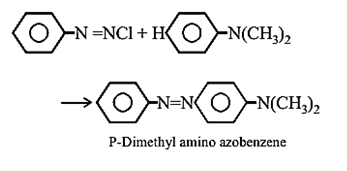
1. Diazo coupling is useful to prepare some
(a) Pesticides
(b) dyes
(c) proteins
(d) vitamins
2. Commonly used antiseptic ‘Dettol’ is a mixture of
(a) o-chlorophenozylenol + terpeneol
(b) o-cresol + terpeneol
(c) phenol + terpeneol
(d) chloroxylenol + terpeneol
3. Which one of the following can possibly be used as analgesic without causing addiction and mood modification?
(a) Diazepam
(b) Morphine
(c) N-Acetyl-para-aminophenol
(d) Tetrahydrocannabinol
4. Which of the following is water-soluble?
(a) Vitamin E
(b) Vitamin K
(c) Vitamin A
(d) Vitamin B
5. Which one of the following is employed as a tranquilizer?
(a) Naproxen
(b) Tetracycline
(c) Chlorpheninamine
(d) Equanil
6. Which one of the following is employed as a tranquilizer drug?
(a) Promethazine
(b) Valium
(c) Naproxen
(d) Mifepristone CHAPTER
7. Which one of the following is employed as Antihistamine?
(a) Chloramphenicol
(b) Diphenyl hydramine
(c) Norothindrone
(d) Omeprazole
8. Which of the following is not a fat soluble vitamin?
(a) Vitamin B complex
(b) Vitamin D
(c) Vitamin E
(d) VitaminA
9. Chloroamphenicol is an:
(a) antifertility drug
(b) antihistaminic
(c) antiseptic and disinfectant
(d) antibiotic-broad spectrum
10. Antiseptics and disinfectants either kill or prevent growth of microorganisms. Identify which of the following statements is not true:
(a) Chlorine and iodine are used as strong disinfectants.
(b) Dilute solutions of Boric acid and Hydrogen Peroxide are strong antiseptics.
(c) Disinfectants harm the living tissues.
(d) A 0.2% solution of phenol is an antiseptic while 1% solution acts as a disinfectant.
11. Dettol is the mixture of
(a) Terpineol and Bithionol
(b) Chloroxylenol and Bithionol
(c) Chloroxylenol and Terpineol
(d) Phenol and Iodine
12. Mixture of chloroxylenol and terpineol acts as :
(1) antiseptic
(2) antipyretic
(3) antibiotic
(4) analgesic
13. Among the following, the narrow spectrum antibiotic is :
(1) Penicillin G
(2) Ampicillin
(3) Amoxycillin
(4) Chloramphenicol
14. Which of the following is a cationic detergent?
(1) Cetyltrimethyl ammonium bromide
(2) Sodium dodecylbenzene sulphonate
(3) Sodium lauryl sulphate
(4) Sodium stearate
15. Given below are two statements :
Statement I : Aspirin and Paracetamol belong to the class of narcotic analgesics.
Statement II : Morphine and Heroin are non-narcotic analgesics. In the light of the above statements, choose the correct answer from the options given below.
(1) Statement I is incorrect but Statement II is true.
(2) Both Statement I and Statement II are true
(3) Both Statement I and Statement II are false
(4) Statement I is correct but Statement II is false
Solutions :
1.Ans: (b) Azon dyes can be prepared by diazotising an aromatic amine and subsequent coupling with a suitable aromatic phenol or amine e.g
2.Ans: (d)
The mixture of chloroxylenol and terpenol are Dettol which is used as antiseptic.
3.Ans: (c)
We know that N – aetyl-para-aminophenol (or paracetamol) is an antipyretic which can also be used as analgesic to relieve pains.
4.Ans: (d)
Vitamin B is water soluble whereas all other are water insoluble.
5.Ans: (d)
Equanil is an important medicine used in depression and hypertension.
6.Ans: (b)
7.Ans: (b)
Diphenyl hydramine also knonw as (Banadry)( is an antihistamine.
8.Ans: (a)
Vitamin B complex is water soluble vitamin whereas vitamin A, D, E and K are fat soluble vitamin.
9.Ans: (d)
Dilute solutions of boric acid and hydrogen peroxide are weak antiseptics.
10.Ans: (b)
11.Ans: (c)
Dettol is a mixture of chloroxylenol and terpineol.
12 (1) antiseptic
13 (1) Penicillin G
14(1) C19H42N+Br–( cationic detergent)
15(2)Aspirin and Paracetamol are non – narcotic where as Morphine and Heroin are narcotic analgesics
Part : II
1. The age of most ancient geological formations is estimated by
(a) Potassium–argon method
(b) Carbon-14 dating method
(c) Radium-silicon method
(d) Uranium-lead method.
2. Emission of an alpha particle leads to a
(a) Decrease of 2 units in the charge of the atom
(b) Increase of 2 units in the mass of the atom
(c) Decrease of 2 units in the mass of the atom
(d) Increase of 4 units in the mass of the atom.
3. If an isotope of hydrogen has two neutrons in its atom, its atomic number and atomic mass number will respectively be
(a) 2 and 1
(b) 3 and 1
(c) 1 and 1
(d) 1 and
4. In a radioactive decay, an emitted electron comes from
(a) The nucleus of atom
(b) The orbit with principal quantum number 1
(c) the inner orbital of the atom
(d) the outermost orbit of the atom.
5. India has the world’s largest deposits of thorium in the form of
(a) rutile
(b) magnesite.
(c) lignite
(d) monazite.
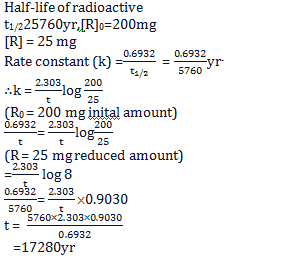
6. Half-life for radioactive 14C is 5760 years. In how many years, 200 mg of 14C will be reduced to 25 mg?
(a) 5760 years
(b) 11520 years
(c) 17280 years
(d) 23040 years
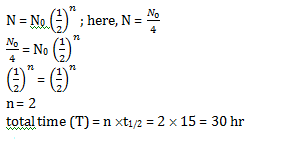
7. One microgram of radioactive sodium Na 24/11 with a half-life of 15 hours was injected into a living system for a bio-assay. How long
will it take for the radioactive subtance to fall up to 25% of the initial value?
(a) 60 hours
(b) 22.5 hours
(c) 375 hours
(d) 30 hours
8. Carbon – 14 dating method is based on the fact that:
(a) C-14 fraction is same in all objects
(b) C-14 is highly insoluble
(c) Ratio of carbon-14 and carbon-12 is constant during disintegration
(d) all the above
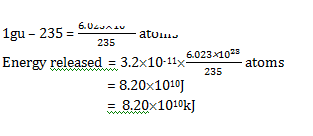
9. + ® Fission products + neutrons +3.20´10-11J . The energy released when 1 g of finally undergoes fission is
(a) 12.75 × 10⁸kJ
(b) 16.40 × 10⁷kJ
(c) 8.20 × 10⁷ kJ
(d) 6.50 × 10⁶kJ
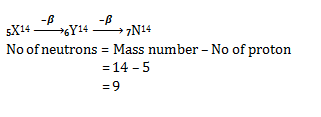
10. Number of neutrons in a parent nucleus X, which gives 14/7 N nucleus, after two successive Eemissions, would be
(a) 9
(b) 6
(c) 7
(d) 8
11. When a radioactive element emits successively one alpha-particle and two beetaparticles, the mass number of the daughter element
(a) is reduced by 4 units
(b) remains the same
(c) is reduced by 2 units
(d) is increased by 2 units
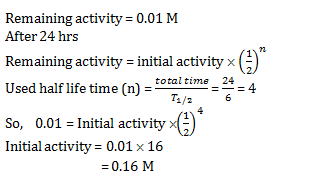
12. Ahuman body required 0.01Mactivity of radioactive substance after 24 hours. Half life of radioactive substance is 6 hours. Then injection of maximum activity of radioactive substance that can be injected will be
(a) 0.08 M
(b) 0.04 M
(c) 0.32 M
(d) 0.16 M
13. If species emits firstly a position, then two a and two b and in last one a and finally converted to species , so correct relation is
(a) c = a – 5, d = b – 12
(b) c = a – 6, d = b – 8
(c) c = a – 4, d = b – 12
(d) c = a – 5, d = b – 8
14. 92U235 nucleus absorbs a neutron and disintegrates into 54Xe139 , 38Sr94 and x. So what will be the product x ?
(a) 3-neutrons
(b) 2-neutrons
(c) alpha-particle
(d) beeta-particle
15. The radioactive isotope, tritium, ( ) has a half life of 12.3 years. If the initial amount of tritium is 32 mg, how many milligrams of it would remain after 49.2 years?
(a) 8 mg
(b) 1 mg
(c) 2 mg
(d) 4 mg
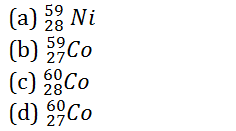
16.The radioactive isotope which is used in the treatment of cancer can be made by (n, p) reaction. For this reaction the target nucleus is
17. Anuclide of an alkaline earth metal undergoes radioactive decay by emission of the alpha particles in succession. The group of the periodic table to which the resulting daughter element would belong is
(a) Gr. 4
(b) Gr. 6
(c) Gr. 14
(d) Gr. 16
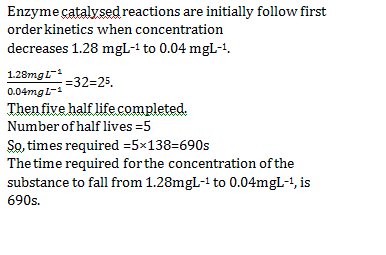
18. The half life of a substance in a certain enzyme catalysed reaction is 138s. The time required for the concentration of the substance to fall from 1.28 mg L-1 to 0.04 mg L– , is:
(a) 414 s
(b) 552 s
(c) 690 s
(d) 276 s
Solutions :
1.Ans: (d) Age of geological formations ( i.e. predicting the age of the earth and rocks) is estimated by U – pb method, also known as helium dating.
Note : – C- 14 dating method is used to predict thte age of fossils or dead animals or a fallen tree.
2. Ans: (a) Emission of a particle ( ) leads to decreases of 2 units of charge. E.g.
92U238 ® 90Th234 + 2He4
3.Ans: (d)As number of neutron = Mass number – atomic number
Give number of neutron =2
Mass number will be 3 and atomic number will be one.
4.Ans: (a) When a radioactive elements emits a or B particle the new element formed may have unstable nucleus. It may further disintegrate by emitting a or B particle forming a new element. This process of integration may continue till end product formed is a stable compound.
5.Ans: (d) The ore of thorium is monazite.
6.Ans: (c)
7.Ans: (d)
8.Ans: (c) Carbon Dating: Radiocarbon, or carbon 14, is an isotope of the element carbon that is unstable and weakly radioactive. The stable isotopes are carbon 12 and carbon 13.
Carbon 14 is continually being formed in the upper atmosphere by the effect of cosmic ray neutrons on nitrogen 14 atoms. It is rapidly oxidized in air to form carbon dioxide and enters the global carbon cycle.
Plants and animals assimilate carbon 14 from carbon dioxide throughout their lifetimes. When they die, they stop exchanging carbon with the biosphere and their carbon 14 content then starts to decrease at a rate determined by the law of radioactive decay.
Radiocarbon dating is essentially a method designed to measure residual radioactivity. By knowing how much carbon 14 is left in a sample, the age of the organism when it died can be known. It must be noted though that radiocarbon dating results indicate when the organism was alive but not when a material from that organism was used.
9.Ans: (c)
10.Ans: (a)
11.Ans: (a)Mass number is effected by emission of a particle while b particle has negligible mass does not effect mass number . e.g.
zXA z-2XA-4 z-2+1XA -4 zXA-4
12.Ans: (d)
13.Ans: (a)
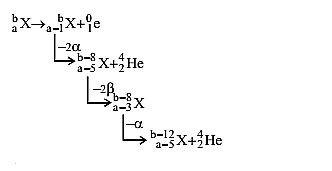
14.Ans: (a)
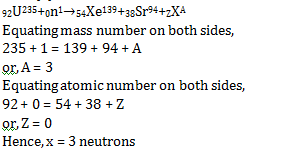
15.Ans: (c)
Half life = 12.3 years
Therefore, 49.2 years = 4 half life
In each half life amount becomes half, after 4 half-lives amount becomes 1/16. Therefore, amount remained =32/16
=2 mg.
16.Ans: (c)
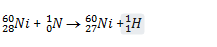
17.Ans: (c) when IIA group element (Ra) emits one a – particle its group no decreases by two units. Ie.. go into zero group (Gr. 16) but as it is radioactive thus due to successive emission last product is pb i.e. (Gr. 14)
18.Ans: (c)